
Category: Measurement Stability Published: 2026/09/10
List card summary: How fixture positioning, ambient noise and operating practices affect repeatability, and how to turn “different” into a number you can track.
The same sample, the same equipment, the same operator, yet the data measured in the morning differs from the data measured in the afternoon. This happens on production lines and in R&D labs alike. To deal with it, first turn “different” into a number you can track, then work back to find the source.
Quantify the Variation Before Talking About Improvement
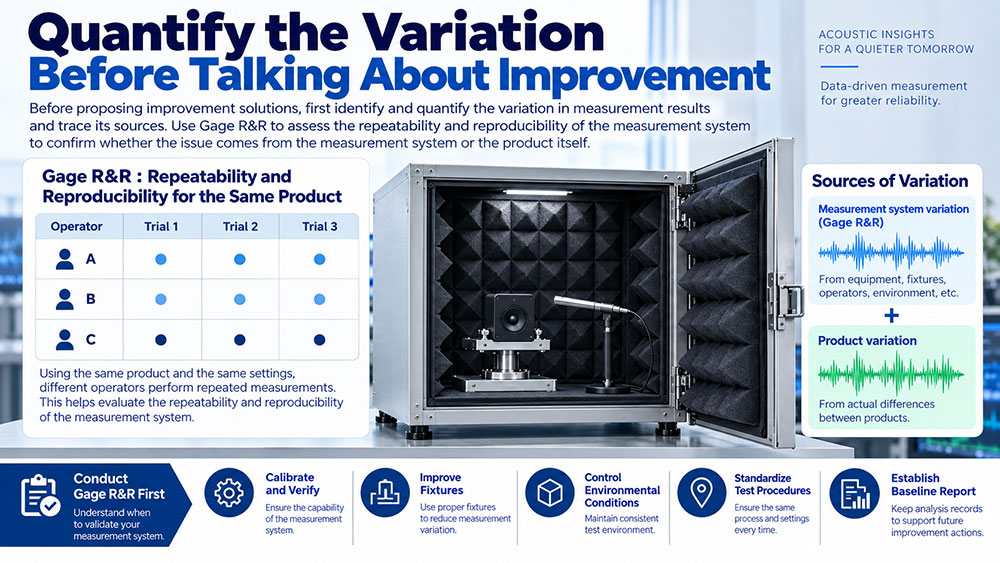
Judging data stability by impression usually ends in a difference of opinion. In practice, use Gage R&R: have different operators repeatedly measure the same set of DUTs, then analyze what proportion of the tolerance is taken up by variation from the measurement system itself. With this ratio, you know whether the problem lies in the measurement system or in the product, and whether an improvement has actually made things better.
Timing matters too. Right after the equipment is delivered, after a fixture is replaced, after a model changeover, or after the line has been rearranged, it is worth running the study again and keeping a baseline for that point in time. Then, if the data is questioned later, you have something to compare against. An analysis report of this kind can be provided together with fixture delivery.
Fixture Positioning Is the Most Common Source
Even a slight difference in distance or angle changes the measured frequency response and sound pressure level. Any step that relies on manual placement or visual alignment is a source of variation. Letting the mechanism fix the distance and angle, rather than relying on operator habits, is the single most effective step.
How the DUT itself is clamped also counts. Too loose and it shifts; too tight and its vibration behavior changes. Both show up in the data. Where the clamping points should go must be designed together with the structure of the DUT, not simply wherever it can be held.
Model changeovers need attention too. A modular fixture replaces only part of its structure while keeping the positioning reference unchanged, which makes consistency easier to maintain than rebuilding a complete set each time.
Changes in Ambient Noise Are Often Overlooked
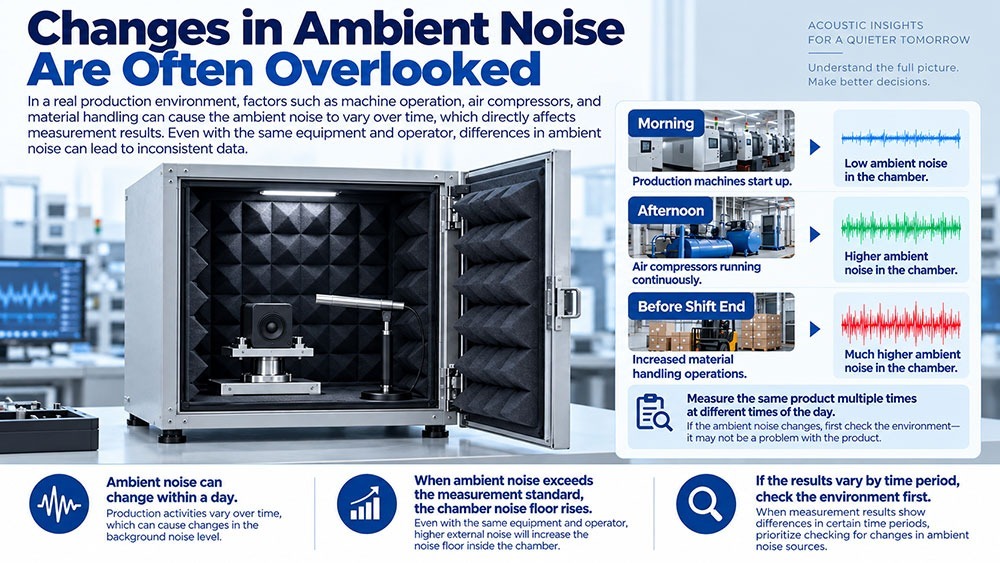
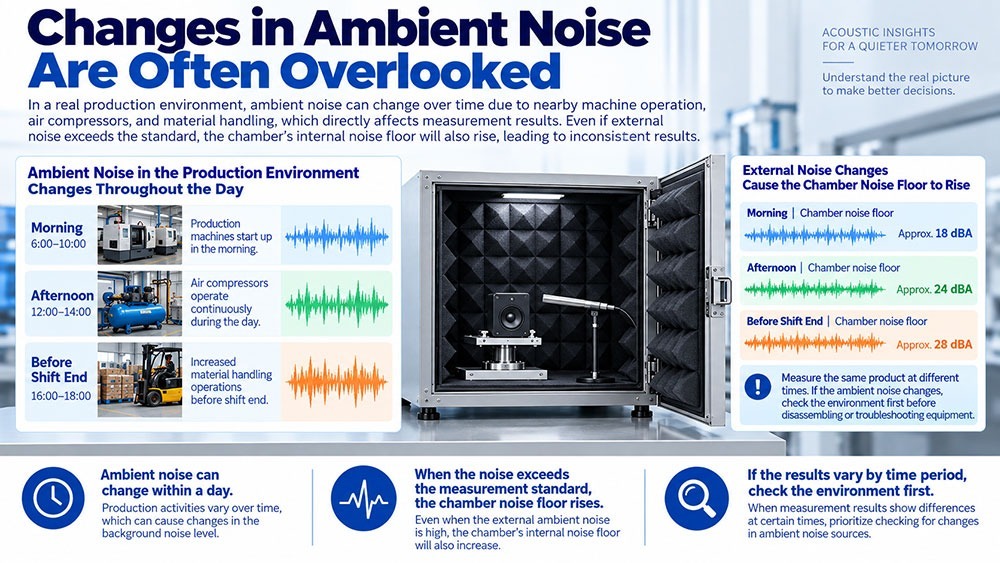
Background noise on a production line changes over the course of a day. A neighboring machine starting up, an air compressor running, material handling before the end of a shift: all of these raise the noise outside the chamber. The sound isolation of a chamber is finite, so once external noise exceeds the original measurement reference, the noise floor inside rises with it.
The check is simple: measure the same sample at different times of day. If the difference changes with the time of day, check the environment first; there is no need to rush into dismantling the fixture.
Write the Operating Procedure Down
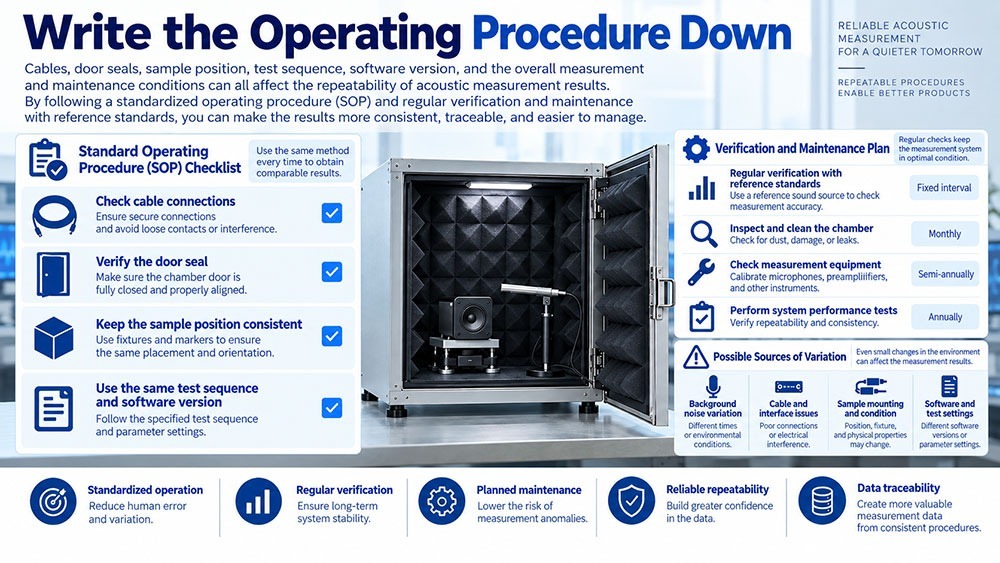
How the cables are routed, whether the door is fully closed, which position the sample goes in, which version of the test sequence is running: if these details exist only in the hands of experienced staff, they will show up in the data as soon as the operator changes. Writing the steps into operating instructions and completing operator training at delivery is the cheapest way to maintain repeatability.
Equipment and Wiring Drift Too
Once the fixture and environment have been ruled out, look further up the measurement chain. The sensitivity of a reference microphone changes with time, temperature and humidity. A changed gain setting on the audio interface, a poor cable connection, or a new version of the sampling parameters or test sequence can all shift the data as a whole.
To check, keep a reference sample in stable condition, measure it at fixed intervals and record the results. Once the data of the reference sample starts to move as well, the problem is not in the DUT but in the measurement system itself.
Regular Inspections Focus on Sealing and Sound Absorption
Aging door seals, loose sound-absorbing material and reduced airtightness all gradually degrade sound isolation. We recommend inspecting the exterior, door seals and sound-absorbing material monthly; checking airtightness and mechanical operation every six months; and performing an acoustic performance calibration and noise floor re-test once a year. Data drift rarely happens suddenly; it builds up from these factors.
If your data is already drifting, send us your DUT and current test conditions, and we can help arrange a measurement repeatability verification.
AI-Acoustics Technology Co., Ltd. service@ai-a.com.tw +886-3-360-9617