
Category: Selection Guide Published: 2026/09/10
List card summary: Whether an anechoic chamber fits your needs comes down to the trade-offs between DUT size, measurement distance, available space on site and sound isolation requirements. The order in which to make these decisions is fairly consistent.
The most common mistake when buying an anechoic chamber is not buying a bad chamber, but buying the wrong one. The sound isolation figures look impressive, yet the DUT does not fit inside; the internal space is generous, yet the unit cannot get through the door on site. Work through the five points below in order, and most misjudgments can be avoided.
Work Backward from the DUT and Measurement Distance to the Internal Space
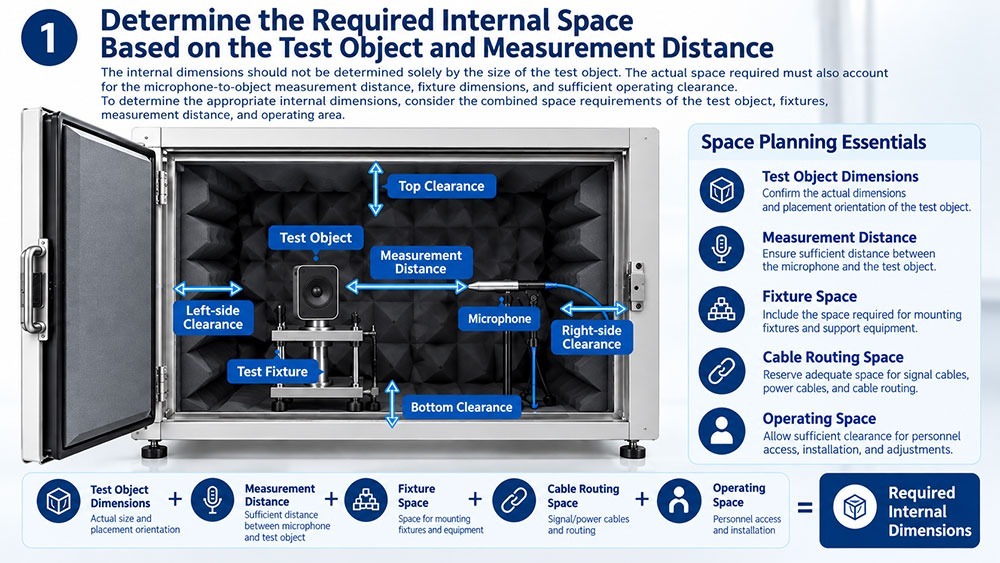
Internal space is not just about whether the DUT fits. You need room for the measurement distance between the microphone and the DUT, the fixture itself takes up space, and there must be clearance for cable bends and for reaching in by hand. In practice, add up the DUT, the fixture and the measurement distance, then leave some working space on top. That is the internal size you actually need.
The standard models can serve as a reference scale. The AC420 has internal dimensions of 380 × 280 × 280 mm (W × D × H), suited to small, component-level DUTs. The AP4 measures 380 × 380 × 380 mm, equal on all three axes, which allows more freedom in positioning. The AC600 and AC680 both measure 640 × 560 × 560 mm, enough for end products such as phones, headphones and small speakers. The AN2 offers 1000 × 1000 × 1000 mm inside, large enough for laptops, tablets and larger assemblies. If the size or measurement distance falls outside these ranges, a custom design is a better investment than squeezing into a standard model.
Match Sound Isolation to the Noise on Site
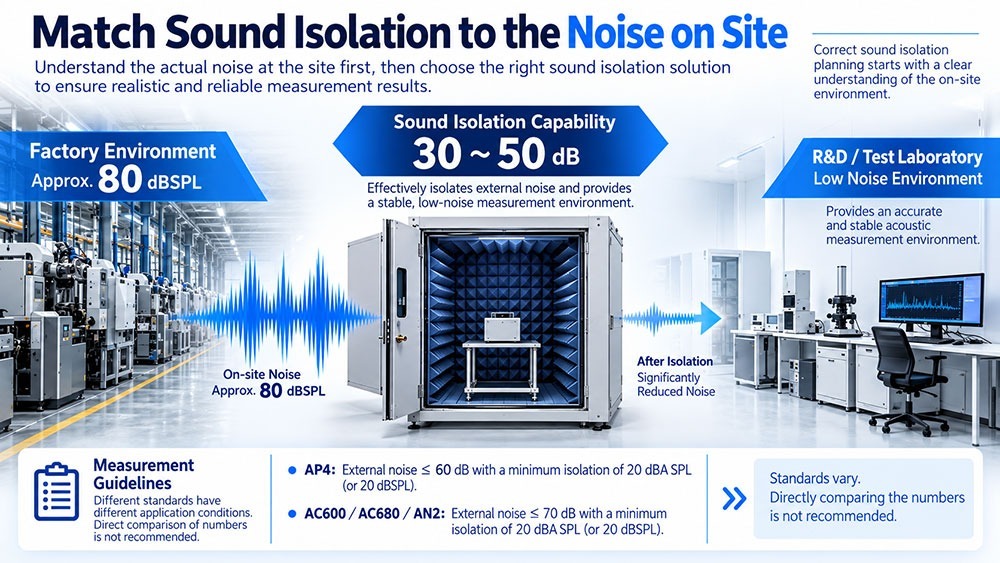
More sound isolation is not always better; it needs to match the site. First measure how noisy the installation location actually is, then go back to the specifications. A typical factory environment is around 80 dB SPL, and the sound isolation of the standard models ranges from 30 to 50 dB. R&D labs are quiet to begin with, so their requirements are naturally lower.
Also pay attention to the reference conditions stated. The noise floor of the AP4 is specified as ≤ 20 dBA SPL when external noise is ≤ 60 dB, while that of the AC600, AC680 and AN2 is ≤ 20 dBA SPL when external noise is ≤ 70 dB. When the reference conditions differ, the figures cannot be compared side by side.
Door Operation Sets the Pace of the Production Line
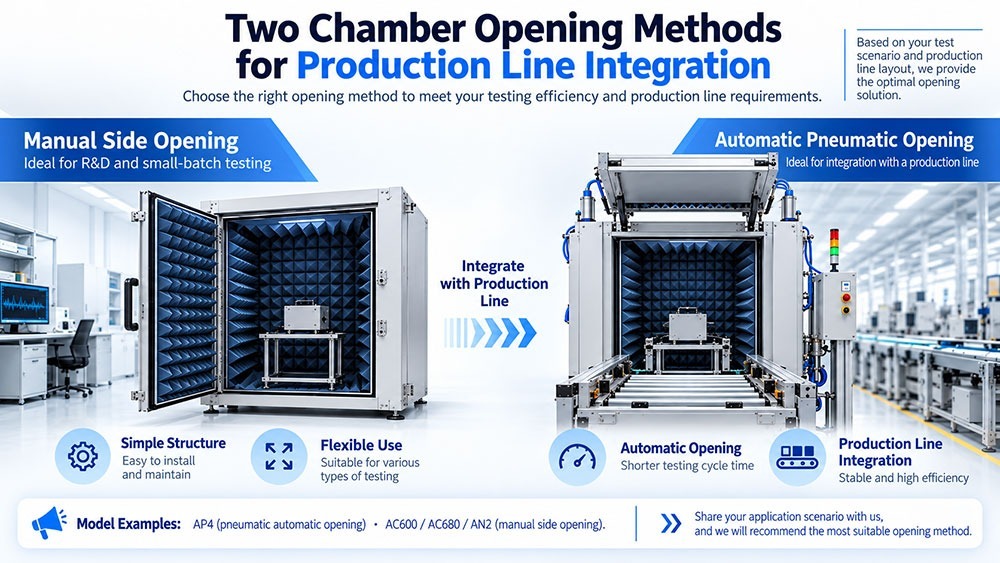
A manual side-opening door suits R&D and low-volume testing, with a simple structure and low cost. A pneumatic automatic door suits production lines with a fixed takt time that need to work in step with loading and unloading mechanisms. Among the five standard models, the AP4 has a pneumatic automatic door and the others have manual doors. This is difficult to change after delivery, so it should be settled at the planning stage.
Plan the Fixture and Measurement Equipment Together
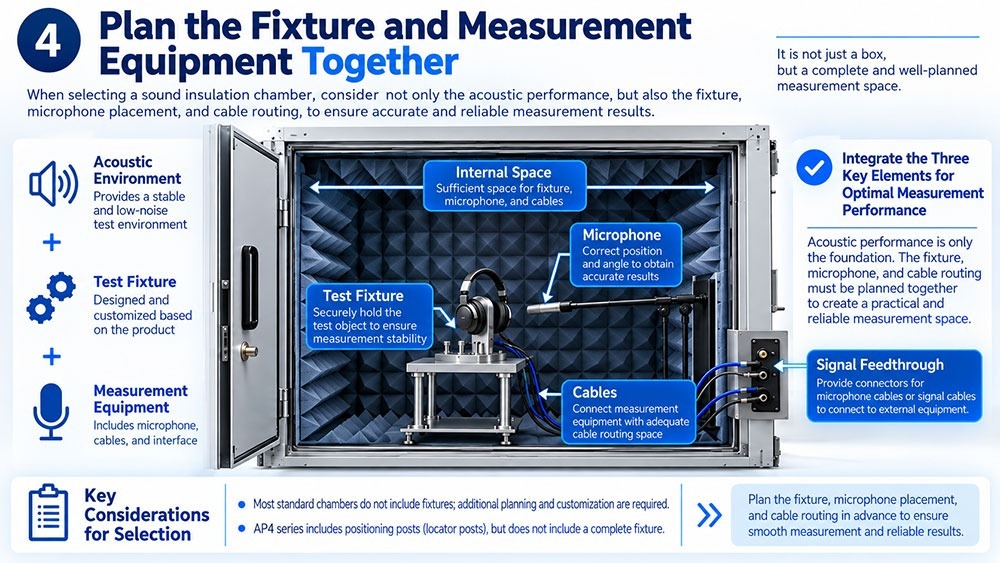
The chamber only provides the environment. How the DUT is held, where the microphone goes and how signals get in and out are matters for the fixture and measurement equipment, and all of them take up space inside the chamber. Apart from the AP4, which includes positioning posts, the standard models do not include fixtures. Factor in the fixture’s volume and cable routing first, so you do not discover a lack of space only after the chamber arrives.
Site Conditions That Are Easy to Overlook
Weight and transport route: the AN2 weighs about 1520 ± 5 kg, or about 1650 ± 5 kg with anti-vibration feet, so check floor load capacity, elevator capacity and corridor width in advance. The AC600 and AC680 weigh about 350 ± 5 kg, the AP4 about 240 ± 5 kg, and the AC420 about 25 kg, light enough for one person to move.
Power and air supply: pneumatic models need a stable compressed air supply on site, and this line is often found missing at the last minute.
Scope of accessories: the AC420 includes neither a cabinet nor a fixture; the AP4 includes a cabinet and positioning posts but no fixture; the AC600 and AC680 include a cabinet but no fixture; the AN2 includes a cabinet, wire mesh and basic lighting but no fixture. Align the scope of accessories before comparing quotes, so the figures are actually comparable.
Put these five points into a one-page requirement before discussing specifications, and you can usually reach agreement in a single round. If the DUT size, measurement distance or site space falls outside the standard range, send us your product and test conditions, and our engineering team will reply with a workable solution.
AI-Acoustics Technology Co., Ltd. service@ai-a.com.tw +886-3-360-9617